
Corrugated boxes are only as good as the partitions inside them. Bottles, jars, electronics, ceramics and fragile spare parts all fail in transit when the clapboard grid is loose, uneven or too late off the line. For converters and packaging plants running high volumes, manual partition assembly has become the hidden bottleneck: six to ten operators standing at a bench, folding and slotting strips by hand, producing 3,000 to 8,000 sets per shift with quality that swings with every new worker.
A fully automatic partition assembler machine removes that bottleneck entirely. Modern clapboard assembly machines feed corrugated sheets, slit and score strips, apply glue, interlock the cells and count stacked partitions at speeds of 20 to 45 sets per minute — with one operator at the HMI instead of a full bench crew. This guide explains how the machine works, what to specify, what it saves and how to choose a supplier you can rely on for years of three-shift production.
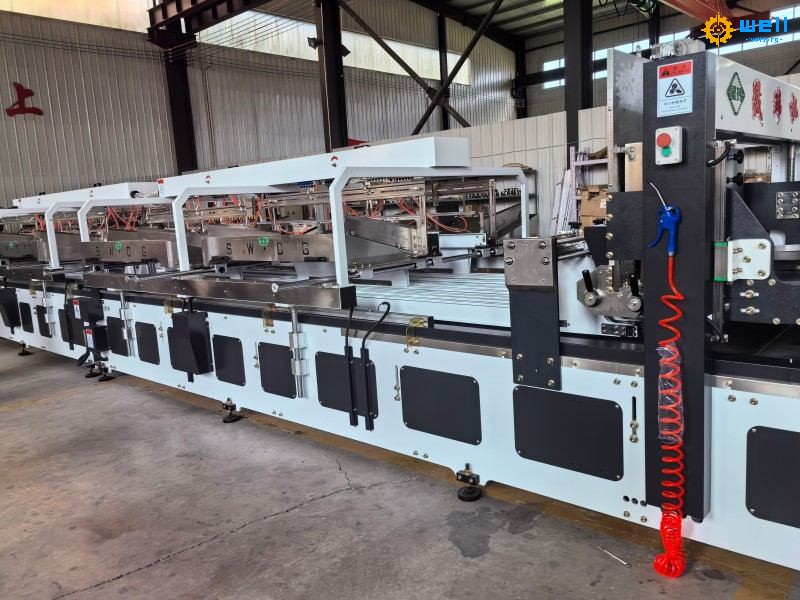
What Is a Fully Automatic Partition Assembler Machine?
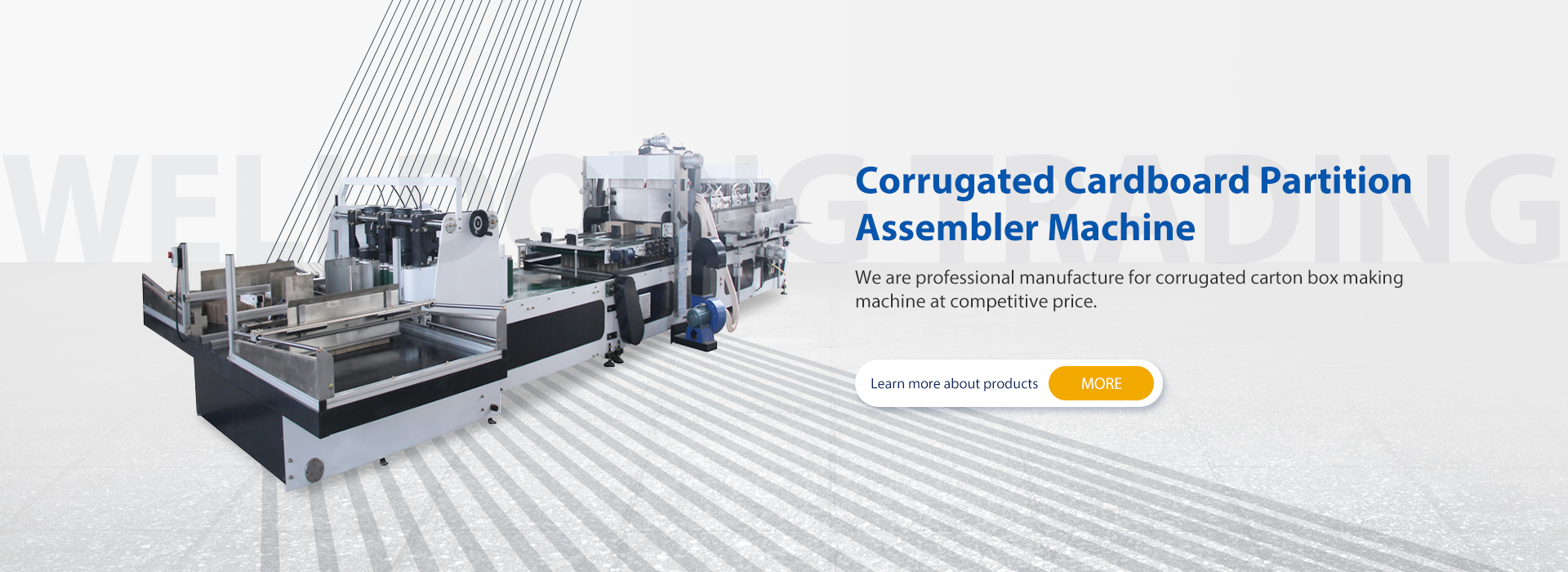
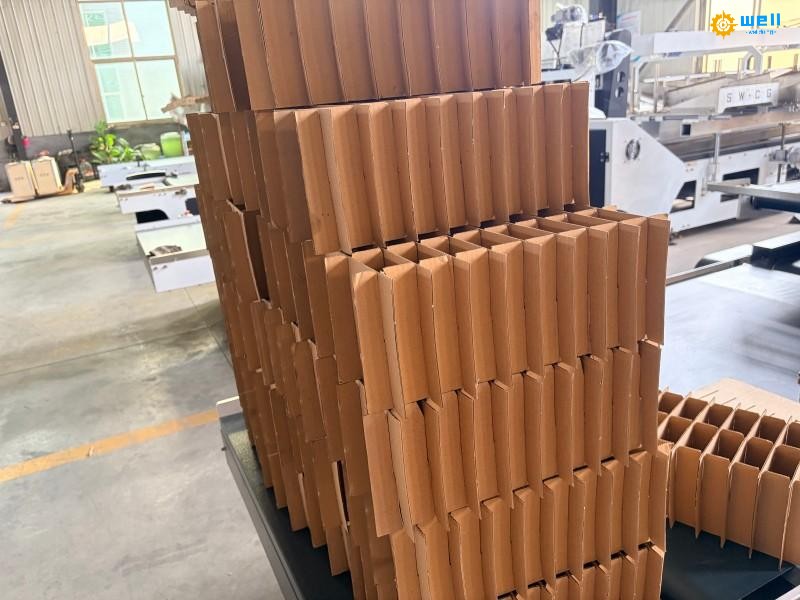
A partition assembler machine (also called a clapboard assembly machine, partition inserting machine or grid partition maker) is automated equipment that turns flat corrugated board into finished honeycomb partitions — the insert grids used inside transport cartons to separate individual products.
The machine combines four functions that are normally done by hand:
- Sheet feeding — lifting and registering corrugated blanks at a controlled rate.
- Slitting and scoring — cutting the half-slots and full-slots that determine the cell pattern.
- Gluing and interlocking — applying a precise glue line, then pushing strips into each other to lock the grid.
- Counting and stacking — delivering counted partition sets, compressed and ready for carton insertion.
The key word is fully automatic: from blank to counted stack, the cycle runs without manual folding, without hand gluing and without a worker judging slot alignment by eye. Semi-automatic models still require an operator to feed strips into a slotting station; a fully automatic partition assembler closes that loop with servo-driven positioning and PLC recipe control.
How the Assembly Cycle Works, Step by Step
Understanding the sequence makes specification far easier.
- Blank loading. A stack of corrugated sheets is loaded onto the feed magazine. Vacuum or friction feeders lift one sheet at a time, and a registration gate squares it before the first cut.
- Slot cutting. Rotary or flat-bed slitting units cut the longitudinal and transverse slots according to the partition pattern. Blade cassettes are swapped when the cell size changes, which typically takes 10 to 20 minutes on a well-designed machine.
- Strip separation and indexing. The slotted sheet is split into individual strips and indexed forward by servo drives, each strip positioned to a repeatability of ±0.3 mm.
- Gluing. A hot-melt or cold glue system applies a controlled bead to the slot intersections. Glue volume is set from the HMI and stays constant across the run, which is where manual assembly loses most of its consistency.
- Assembly and interlocking. Strips are pushed together so slots engage. The carton partition assembly machine holds pressure briefly to let the bond set, forming a rigid honeycomb block.
- Counting, compression and discharge. Finished partitions are counted by sensor, compressed to remove air, and stacked in a preset batch — usually 50 or 100 sets — ready for the packing line.
Cycle time for a standard 3×4 or 4×5 pattern typically runs 1.5 to 3 seconds per set, giving real-world output of 20 to 45 sets per minute depending on cell count and board grade.
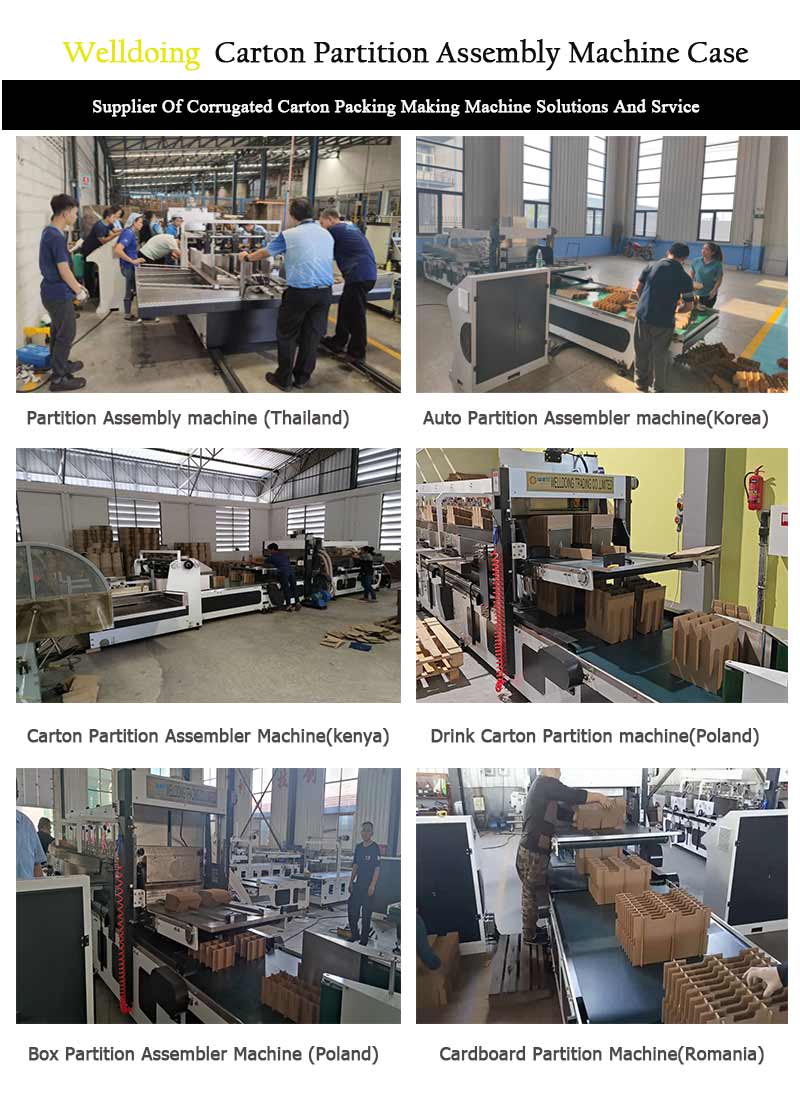
Core Components and Engineering Details Worth Checking
The difference between a machine that runs for a decade and one that fails in eighteen months is usually in the components, not the brochure.
- Frame and rigidity. A heavy welded frame with machining after welding keeps blade alignment stable. Light frames vibrate at high speed, and vibration shows up as ragged slot edges.
- Servo drive train. Independent servo axes for feed, indexing and assembly give repeatable positioning and fast recipe changeover. Look for closed-loop feedback rather than inverter-controlled motors.
- Blade and slotting system. Hardened or carbide-tipped blades, quick-release cassettes and a motorized blade-height adjustment reduce changeover time significantly.
- Gluing system. A gear-pump or pressure-tank glue unit with a digital regulator maintains bead size as viscosity drifts. Hot-melt systems suit high-speed lines; cold glue suits lower volumes and easier cleanup.
- PLC and HMI. Recipe memory for 50 to 200 partition patterns lets an operator call up a job instead of re-setting cams by hand. Touchscreen with fault diagnosis shortens troubleshooting.
- Safety and compliance. Guarded moving parts, interlocks, emergency stop circuits and CE or UL documentation where required. Ask for the safety schematic, not just a certificate photo.
- Stacking and counting. Photoelectric counting with batch preset, plus a compression station so partitions arrive flat and square.
Typical Technical Parameters
- Partition cell size range: 30 × 30 mm to 200 × 200 mm (custom tooling above this range)
- Board thickness: 1.5 mm to 7 mm, single-wall or double-wall corrugated
- Maximum sheet width: 1,200–1,600 mm depending on model class
- Production speed: 20–45 sets per minute; up to 60 sets on high-speed configurations
- Positioning repeatability: ±0.3 mm
- Glue system: hot melt 1–3 kg/h or cold glue tank 20–40 L
- Control: PLC + servo, 7–10 inch touch HMI, 100+ recipe memory
- Air supply: 0.6–0.8 MPa, dry and filtered
- Power: 380 V / 50 Hz three phase, 8–15 kW typical
- Operators required: 1 (feeding and inspection), 2 on high-speed lines
Why Automating Clapboard Assembly Pays Back Fast
Labor. Replacing a six-person manual bench with one operator plus one helper releases five people to higher-value work — or removes five hires from the plan. At a fully loaded labor cost of USD 700–1,200 per operator per month in most export-driven manufacturing regions, the saving alone frequently covers machine investment within 12 to 20 months.
Material yield. Manual slitting wastes board through mis-cuts, and hand gluing burns through glue. A fully automatic partition assembly machine with servo indexing typically lifts board utilization by 3–6 percent and cuts glue consumption by 15–25 percent because the bead is metered, not squeezed from a bottle.
Consistency. Carton packers reject partitions that do not sit square. Machine-assembled grids hold ±0.3 mm cell tolerance, so automatic carton erectors and case packers downstream stop jamming on misaligned inserts.
Throughput matching. When a flexo folder gluer is running 150 boxes per minute, manual partition supply cannot keep up. An automatic clapboard assembly machine sized to the line removes the buffer stock and the second shift.
Traceability and uptime. Recipe-based production means the same job runs identically next month, next quarter and on the next shift — a real advantage when customers audit packaging quality.
Where the Machine Fits in Production
- Corrugated box plants adding partition supply as a value-added service to existing customers.
- Glass, bottle and jar packers needing dense honeycomb grids for beverage and food logistics.
- Electronics and appliance manufacturers using molded and corrugated partition combinations.
- Ceramic, lamp and automotive parts operations where impact protection is critical.
- Third-party packaging converters running many small partition jobs and needing fast changeover.
- E-commerce fulfillment operations supplying dividers for multi-item parcel sorting.
How to Choose a Reliable Partition Assembler Machine Supplier
A machine is a ten-year commitment, so evaluate the supplier on serviceability as heavily as on price.
- Ask for a live video run, not only photos. Request a demonstration on your actual board grade and cell pattern, with the counter visible and the clock running.
- Check the tooling strategy. Who supplies blades, cassettes and glue nozzles? What is the lead time and price for a spare set? Tooling availability decides your real lifecycle cost.
- Verify changeover time in writing. Get the supplier to state slot-changeover minutes for two of your patterns, and hold it in the contract.
- Confirm electrical and safety standards. Match voltage, frequency, phase and certification to your destination market before signing.
- Review documentation. Operation manual, electrical schematic, spare parts list, PLC backup and a commissioning checklist should all be deliverables.
- Test the support channel. Response time, remote diagnostics capability, engineer dispatch lead time, and whether spare parts ship from stock or from the factory.
- Ask for reference customers running the same model in your region or industry, and call them.
Maintenance That Keeps Uptime High
Daily: clean glue lines and nozzles, check air pressure and drain filters, inspect blade edges for chipping. Weekly: verify slot depth with a gauge, lubricate guide rails, confirm sensor alignment at the counting station. Monthly: check belt tension and servo repeatability with a test pattern, audit guard interlocks. Keep two spare blade cassettes and one glue pump on the shelf — those three items account for most unplanned stops on any partition assembler machine.
FAQ
What is the difference between a partition assembler and a partition inserter? An assembler builds the honeycomb grid from corrugated strips. An inserter places the finished partition into a carton. Many lines use both, often linked by a conveyor.
Can one machine handle different cell sizes? Yes. Recipe-driven models store dozens of patterns, and changeover is handled by swapping blade cassettes plus calling up the recipe — typically 10 to 25 minutes.
What board grades can it run? Most machines accept 1.5–7 mm single-wall and double-wall corrugated, plus some solid fiber board. Confirm with the supplier using your exact board sample.
What is typical delivery and installation time? Standard models ship in 30–45 days; installation and commissioning usually take 3–5 days on site, including operator training.
What is the ROI period? For a plant replacing a six-person manual bench, payback commonly lands between 12 and 20 months from labor and material savings alone.
Conclusion
Manual partition assembly caps your carton output, drains labor and quietly generates rejects downstream. A fully automatic partition assembly machine converts that constraint into a controlled, recipe-driven process with ±0.3 mm precision and 20–45 sets per minute.
As an experienced clapboard assembly machine supplier, Welldoing builds partition assembler machines engineered for continuous three-shift operation — servo positioning, hardened quick-change tooling, metered glue systems and full documentation for export markets. Send us your partition drawing, cell size, board grade and target output; we will return a matched configuration, a tooling list and a realistic delivery schedule.
Email:cartonmachine.tomwang@aliyun.com
Phone/Wechat/Whatsapp:+86 133 0307 8975
Post time: Nov-09-2026